
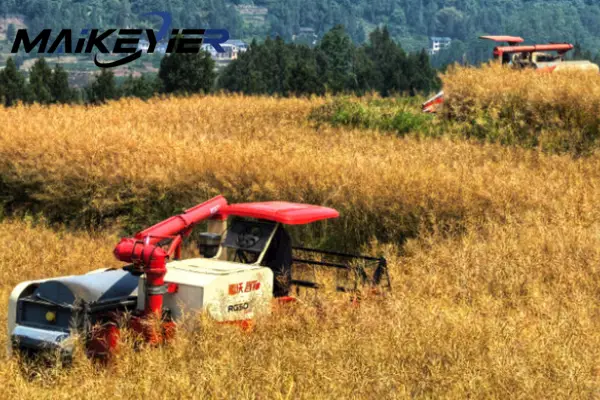
When combine harvesters operate in the field, their core components endure continuous high loads, impact, and wear, making them one of the most intensively worked machines in agriculture. The service life of these components determines the harvester’s working window, and high-quality parts can last through an entire harvest season. This is why we recommend choosing forged parts for critical positions — compared with castings or ordinary machined parts, forged parts offer significant advantages in strength, toughness, and service life.
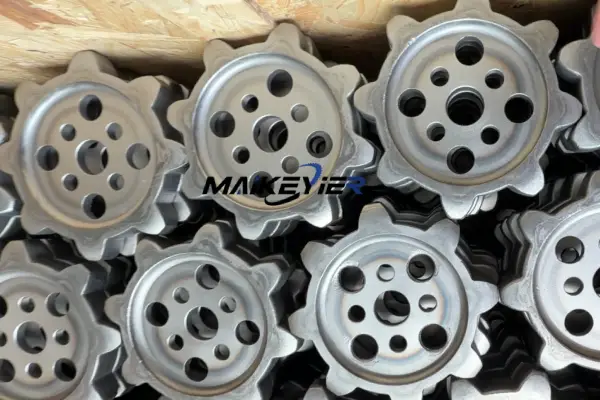
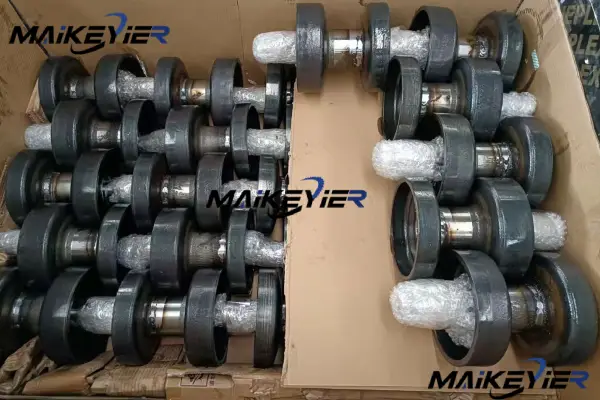
What Are Forged Parts?
Forging is a metal forming process: after heating a metal billet to forging temperature, pressure is applied through forging machinery to cause plastic deformation in the solid state, thereby obtaining the desired shape and internal structure. Because the steel is “deformed” rather than poured or cut, its internal grains are refined and reoriented along the final shape of the harvester part.
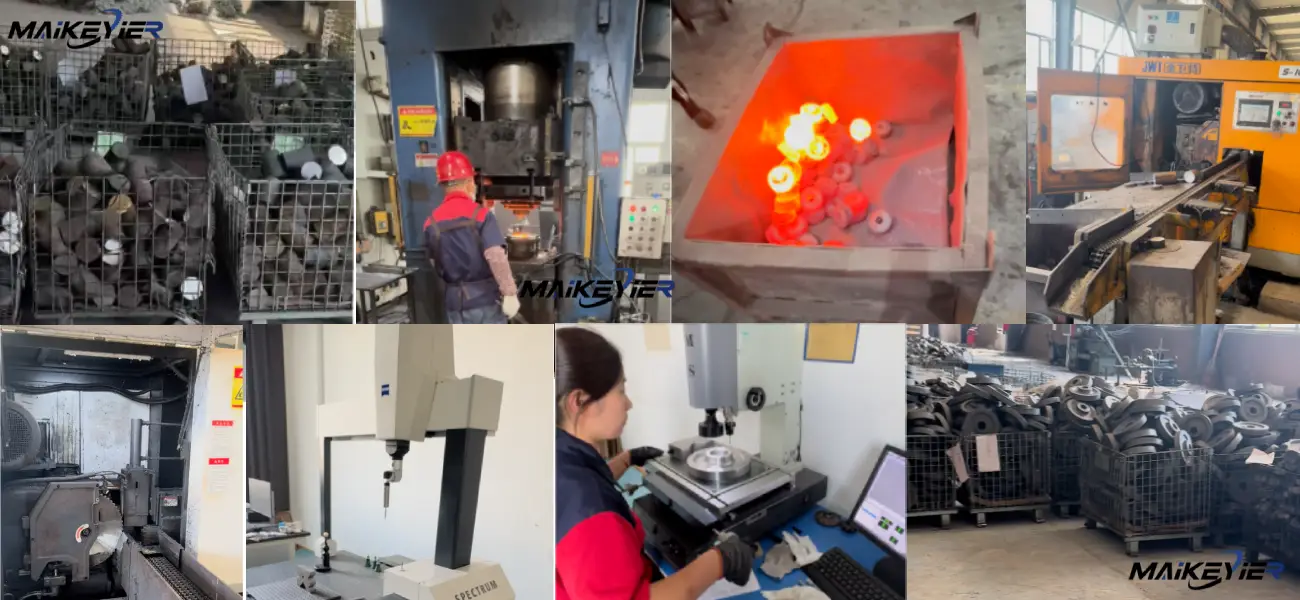
Hot Die Forging Production Process
- Billet cutting: Bar stock is cut to precise weight (weight control is the first quality gate).
- Medium-frequency induction heating : Billets are heated to 1150–1250°C to ensure uniform plasticity.
- Die forging: Formed in a closed die with one or more blows, with minimal flash.
- Trimming : Flash around the parting line is removed.
- Normalizing : Reheated and air-cooled to refine grains and relieve forging stress.
- Shot blasting and inspection : Scale is removed; dimensions and surface defects are checked.
- Machining : Faces, holes, and bores are machined to final tolerances.
- Heat treatment : Overall quenching and tempering + induction hardening of working surfaces.
Forging Methods
- Hot die forging (closed-die forging) : The standard process for harvester parts: best flow lines, tight tolerances, suitable for medium-to-large batch production.
- Open-die forging : Forging large, simple shapes between flat dies (blocks, long shafts), used for oversized or small-batch parts.
- Roll forging : Reducing the cross-section of long parts such as shafts and cutter bar blanks.
Characteristics
- Metal is formed under pressure in the solid state; internal grains are crushed and rearranged along the deformation direction, forming continuous metal flow lines.
- Internal defects such as porosity and shrinkage are welded and compacted during forging.
- The product has a dense structure and excellent mechanical properties.
- Suitable for manufacturing key components that withstand high stress, high impact, and high fatigue loads.
Forged Parts vs. Castings vs. Machined Parts
| Comparison Aspect | Forged Parts | Castings | Machined Parts (cut from bar/plate) |
| Forming method | Plastic deformation in solid state | Liquid pouring and forming | Material removed by cutting |
| Internal structure | Dense, refined grains, metal flow lines | Possible porosity, shrinkage, segregation | Original structure of raw material |
| Tensile strength | High | Medium-low | Depends on raw material |
| Impact toughness | Excellent | Poor | Average |
| Fatigue resistance | High | Low | Medium |
| Material utilization | High (near-net shape) | Medium | Low (large amounts of chips wasted) |
| Suitable shapes | Medium complexity | High complexity | Simple shapes |
| Typical applications | Cutter bars, gears, connecting rods, track rollers | Housings, casings, complex structural parts | Shafts, sleeves, small-batch parts |
Why Do Combine Harvesters Need Forged Parts?
Withstanding high impact loads: When a combine harvester operates in the field, the cutter bar strikes stones and hard soil. Because forged parts have complete metal flow lines and a dense structure, they offer excellent impact toughness and are not prone to fracture under sudden impact.
Withstanding high fatigue loads: During the harvest season, harvesters often work continuously for 12–16 hours a day for weeks. Forged parts deliver excellent fatigue resistance.
Withstanding high-stress wear: Forged parts can flexibly adjust surface hardness and core toughness through heat treatment (quenching, tempering, carburizing, medium-frequency hardening, etc.). High surface hardness provides wear resistance; good core toughness provides impact resistance.
Ensuring dimensional accuracy and assembly consistency: Forging uses die forming, combined with subsequent precision machining, to achieve high dimensional accuracy and batch consistency.
Reducing overall cost of use: The initial purchase price of forged parts is usually higher than that of castings, but from a life-cycle cost perspective, the overall cost is lower.
Which Components on a Combine Harvester Should Use Forged Parts?
| System | Components Recommended for Forging | Reason |
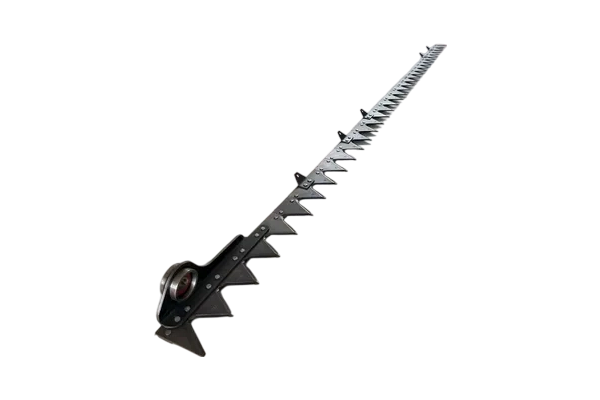
| Cutting system | Cutter bars, blades, knife guards, knife heads | High impact, high wear; require sharp edges and fracture resistance |
| Drive system | Gears, sprockets, drive shafts, connecting rods | High torque, alternating loads; require fatigue resistance |
| Classis system | Track rollers, drive sprockets, idler wheels, tensioner arms | Bear the machine’s weight; withstand impact and wear |
| Threshing system | Threshing tooth bars, threshing bow teeth | High-speed impact with crops; require wear and fracture resistance |
| Conveying system | Sprockets, auger shaft ends | Transmit torque; require strength |
| Hydraulic system | Hydraulic fittings, high-strength connectors | Withstand high pressure; require reliable sealing |
How to Identify High-Quality Forged Parts
| Judgement Aspect | Characteristics of High-Quality Forged Parts | Signs of Inferior Parts |
| Material | Material test report (MTR) provided; spectrographic analysis meets standards | No material certificate; material unknown |
| Process | Complete metal flow lines, dense structure | Porosity, shrinkage, slag inclusions |
| Hardness | Hardness test report provided; uniform and up to standard | Uneven hardness, or too hard and brittle |
| Dimensions | High precision; mounting holes accurate | Large dimensional deviations; difficult assembly |
| Appearance | Smooth surface; no cracks, laps, or burrs | Rough surface; cracks or laps |
| Batch consistency | No obvious differences between batches | Large quality fluctuations between batches |
Frequently Asked Questions (FAQ)
Maikeyier is an agricultural parts factory with forging manufacturing capability at its core, possessing a complete hot die forging production line and heat treatment process system, focusing on producing high-strength, high-wear-resistant, long-life forged agricultural parts.
Whether you need standard replacement parts, OEM-equivalent parts, or forged parts customized to drawings, welcome to contact Maikeyier. We can provide a one-stop solution from manufacturing to supply.