
Forged Parts and Casting Parts are both common manufacturing methods for agricultural machinery components. The manufacturing method of a component directly determines the reliability, operational efficiency, and maintenance costs of the equipment. If you are selecting cost-effective parts for your machinery, we have prepared a detailed introduction covering material structure, mechanical properties, durability, service life, and application scenarios – hoping to help you choose the most satisfactory agricultural parts products.
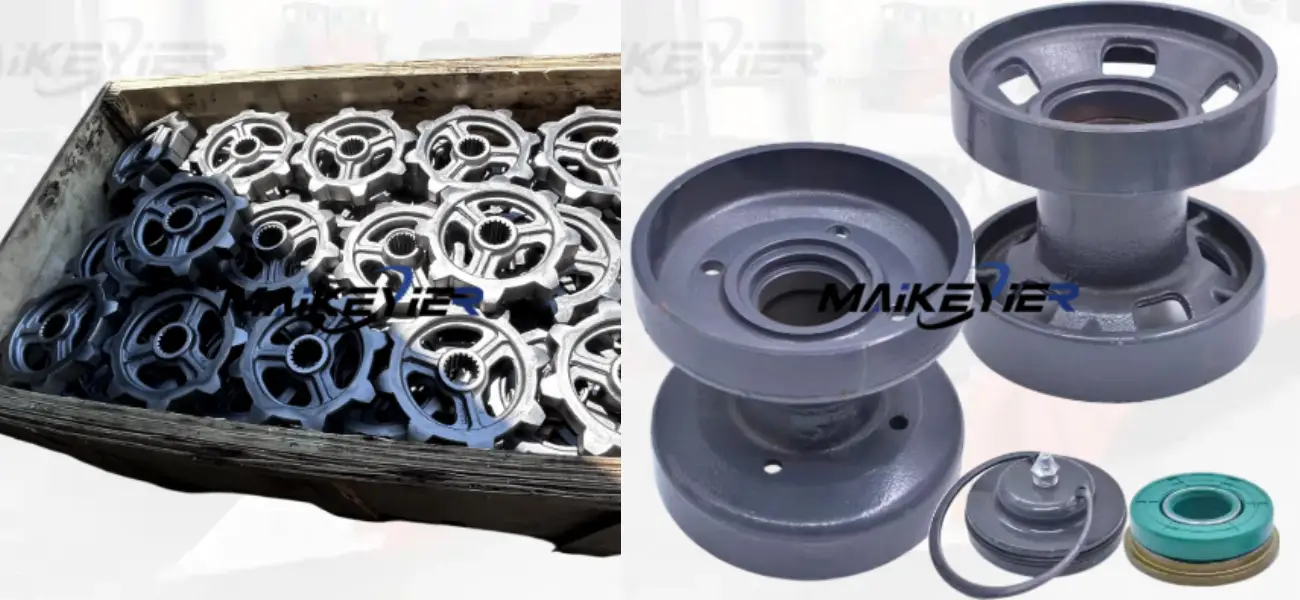
Manufacturing Process Comparison
The fundamental difference between forging and casting lies in the metal forming process, which dictates the essential distinctions in the final product’s internal microstructure and performance. As a specialized manufacturer and trader of forged agricultural machinery parts, Maikeyier operates a comprehensive hot die forging line equipped with high-tonnage forging presses and automated heating systems; simultaneously, the company maintains stable partnerships with multiple foundries, enabling it to provide one-stop solutions for all customer needs.
Forging Process
Forging is a processing method that uses forging machinery to apply pressure to a metal billet, causing it to undergo plastic deformation in the solid state, thereby obtaining a component with a specific shape, dimensions, and internal structure.
Process Flow:
Raw material cutting → Heating (heating the metal to forging temperature) → Forging forming (deforming the metal through hammering or pressing) → Trimming/punching → Heat treatment (quenching, tempering, normalizing, etc.) → Precision machining → Quality inspection → Finished product
Characteristics:
- The metal undergoes plastic deformation under pressure in the solid state; internal grains are crushed and rearranged along the deformation direction, forming continuous metal flow lines.
- Internal defects such as porosity and shrinkage are welded and compacted during the forging process.
- The product exhibits anisotropy; mechanical properties along the flow line direction are significantly better than those perpendicular to the flow line direction.
- Suitable for manufacturing key components that bear high stress, high impact, and high fatigue loads.
Casting Process
Casting is a processing method in which molten metal is poured into a mold cavity, allowed to cool and solidify, to obtain a component of the desired shape and properties.
Process Flow:
Mold/mold making → Metal melting (heating the metal to a liquid state) → Pouring (injecting molten metal into the mold) → Cooling and solidification → Demolding and sand cleaning → Subsequent processing (heat treatment, machining, etc.) → Quality inspection → Finished product
Characteristics:
- The metal fills the mold in a liquid state and can form any complex shape.
- The internal structure is isotropic; mechanical properties are essentially uniform in all directions.
- Prone to internal defects such as porosity, shrinkage, segregation, and inclusions.
- Suitable for manufacturing structural parts with complex shapes and relatively low strength requirements.
Performance Comparison
| Performance Indicator | Forged Parts | Casting Parts |
| Tensile strength | High – due to complete metal flow lines and dense structure | Low to medium – significantly affected by internal defects |
| Yield strength | High | Low to medium |
| Impact toughness | Excellent – refined grains and reasonably distributed flow lines | Poor – internal defects easily become crack initiation sites |
| Fatigue strength | High – suitable for alternating load conditions | Low – defects easily initiate fatigue cracks |
| Hardness | Flexibly adjustable through heat treatment | Limited by material and cooling conditions |
| Internal structure | Dense, defect-free, refined grains | Possible porosity, shrinkage, segregation |
| Metal flow lines | Present, reasonably distributed along stress direction | None |
| Dimensional accuracy | Relatively high – near-net shape + finishing | General – requires subsequent machining to ensure |
Durability Differences
Durability is one of the most important factors in agricultural parts procurement, directly affecting equipment maintenance frequency and total operating costs. While the unit price of casting parts is lower than that of forged parts, the durability of forged parts is far superior – offering significantly better overall cost-performance.
Durability Advantages of Forged Parts
Due to their dense internal structure and rational distribution of metal flow lines, forged parts exhibit excellent fatigue resistance when subjected to repeated impact and high-load alternating stress. The failure mode of forged parts is typically gradual wear rather than sudden fracture, providing operators with early warning time for inspection and replacement.
Under the same operating conditions, the service life of high-quality forged parts is usually 1.5 to 3 times that of casting parts. For harvester parts subject to high-frequency stress, the durability advantage of forged parts is particularly pronounced.
Durability Limitations of Casting Parts
Casting parts may contain internal micro-defects such as porosity and shrinkage. These defects easily become initiation sites for fatigue cracks under alternating stress. The failure mode of casting parts often occurs suddenly – fracturing without warning signs, potentially leading to equipment downtime or even safety accidents. In addition, the wear resistance of casting parts is also constrained by the uniformity of the internal structure; local segregation or loose areas will wear preferentially, affecting overall service life.
Complexity Differences
| Dimension | Forged Parts | Casting Parts |
| Shape complexity | Limited by forging process; suitable for relatively simple shapes (e.g., gears, shafts, blades, brackets, etc.) | Can form any complex shape, including internal complex cavities (e.g., housings, shells, pipe fittings, etc.) |
| Size range | Wide range of single-part weights, but very large forgings limited by equipment tonnage | Can produce castings from a few grams to dozens of tons |
| Wall thickness uniformity | Variable cross-section design possible, but transition areas must consider metal flow | Flexible wall thickness design, enabling complex internal and external structures |
| Subsequent machining | Near-net shape with small machining allowance | Generally requires larger machining allowance |
Cost Differences
| Cost Dimension | Forged Parts | Casting Parts |
| Die/tooling cost | Relatively high (forging dies must withstand high temperature and pressure) | Relatively low (mold materials are comparatively cheaper) |
| Equipment investment | High (large forging equipment requires significant investment) | Medium (melting and pouring equipment are relatively economical) |
| Material utilization | Relatively high (near-net shape + rational design can reach 80-90%) | Medium (gating systems and risers consume some metal) |
| Unit production cost | Higher per unit in batch production | Lower per unit in batch production |
| Lifecycle cost | Long life, low total replacement cost | Short life, frequent replacement increases total cost |
| Downtime loss cost | Low (high reliability, fewer sudden failures) | High (risk of sudden fracture causing unexpected downtime) |
Agricultural Parts Application Comparison
Maikeyier, as a professional agricultural parts forging factory, produces core products using high-quality alloy steels (20CrMnTi, 40Cr, 42CrMo, etc.) through hot die forging + heat treatment strengthening + precision machining, ensuring reliable durability of each product under high-intensity field operating conditions.
Harvester Parts – Scenarios Where Forging Is Recommended
| Part Name | Reason | Failure Risk (if using casting) |
| Cutter blade holder | Continuously bears cutting reaction force; high impact load | Fracture causes blade detachment and missed cutting |
| Reel finger | High-speed rotation + high-frequency elastic deformation; requires high fatigue strength | Fracture causes reel failure and crop lodging |
| Gear | Bears high torque and alternating bending stress | Tooth breakage causes transmission interruption and machine shutdown |
| Shaft | High torque transmission; requires high torsional and bending strength | Fracture causes power interruption |
| Connecting rod | Reciprocating motion + alternating tension-compression stress | Fracture causes system failure |
| Load-bearing bracket | Bears whole machine weight and operational impact | Deformation or fracture causes structural instability |
Harvester Parts – Appropriate Scenarios for Casting
| Part Name | Reason | Note |
| Engine housing | Complex shape requiring integration of multiple mounting surfaces and internal oil passages | Casting defects must be strictly controlled to avoid oil leakage |
| Gearbox housing | Complex internal structure accommodating multiple gears and shaft systems | Wall thickness design must ensure strength and rigidity |
| Covers/guards | Mainly for protection and sealing with minimal load | Appearance requirements high; casting defects affect appearance and protection |
| Flywheel housing | Transition component connecting engine and transmission system | Must ensure mounting surface flatness and positional accuracy |
| Pulley | Simple shape, mainly bears radial force | Casting defects may cause dynamic imbalance |
How to Choose Forging or Casting for Your Agricultural Parts Procurement?
For core transmission and load-bearing components of agricultural machinery, the performance advantages brought by forging cannot be replaced by casting. However, for most exterior parts, casting can effectively reduce costs. In short: choose forging for critical load-bearing parts; choose casting for structural and exterior parts.
| Decision Dimension | Priority: Forging | Priority: Casting |
| Stress state | High impact, high stress, alternating loads | Static or low-stress loads |
| Failure consequences | Fracture causes severe downtime accidents | Failure does not cause major losses |
| Shape complexity | Relatively simple, suitable for forging | Complex internal cavities or irregular shapes |
| Procurement budget | Focus on whole-lifecycle cost | Strictly control initial procurement cost |
| Operating environment | Harsh, high load, long operating hours | Light load, intermittent operation |
| Quality requirements | High batch consistency and strict strength standards | Appearance and dimensions meeting basic requirements |
Maikeyier specializes in producing high-strength, high-wear-resistance, long-life forged agricultural parts. Whether you are a dealer looking for a reliable forged parts supplier or a wholesaler seeking to optimize existing product quality, feel free to contact Maikeyier.