
In the heat treatment process for agricultural machinery undercarriage parts such as drive sprockets, track rollers, and gears, quenching is the critical step that determines wear resistance and service life. Different quenching methods vary in heating depth, hardened layer distribution, and applicable scenarios – which is why we often see harvester parts that look identical but differ several times over in field life. Today, let’s look together with Maikeyier at what each process actually is, where its strengths lie, and how to choose the right process for the part at hand.
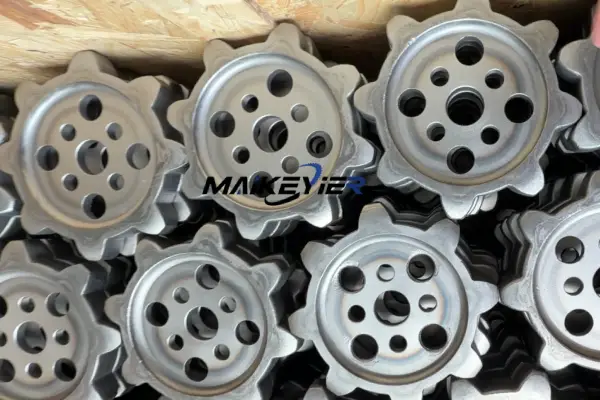
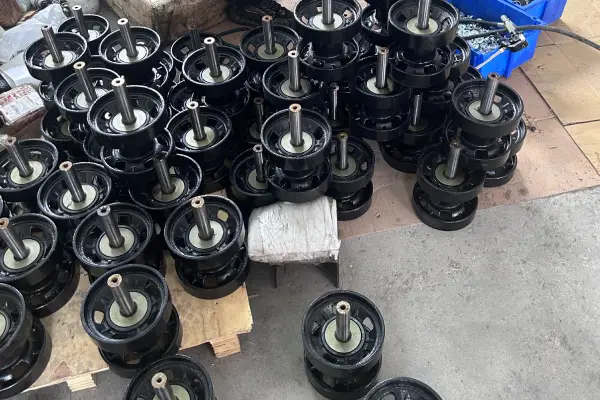
What Is Heat Treatment? Why Is It So Important for Harvester Parts?
Heat Treatment is a process method that changes the internal microstructure of a metal material in the solid state through heating, holding, and cooling to obtain the desired mechanical properties. Heat treatment does not change the shape of the part – it is used to improve hardness, strength, toughness, wear resistance, and fatigue resistance.
| Purpose | Description |
| Improve hardness and wear resistance | Makes tooth surfaces and working surfaces more wear-resistant, extending service life |
| Improve strength and toughness | Achieves good overall mechanical properties to withstand impact and alternating loads |
| Improve machinability | Lowers hardness to facilitate subsequent turning, drilling, and spline broaching |
| Relieve internal stress | Prevents deformation and cracking during processing or use |
| Improve fatigue resistance | Extends the life of gears, shafts, drive sprockets, and other parts |
Basic Concepts of the Three Quenching Processes
Among all heat treatment paths (annealing, normalizing, tempering, carburizing, nitriding, etc.), three quenching methods dominate harvester parts production: high-frequency induction hardening, medium-frequency induction hardening, and through hardening. They use different energy sources and produce distinctly different hardness distributions.
High-Frequency Hardening
| Item | Description |
| Frequency range | 100 kHz – 1000 kHz (commonly 200–300 kHz) |
| Heating principle | Uses the skin effect of high-frequency current to rapidly heat the workpiece surface, followed immediately by water spray or immersion cooling |
| Heating depth | 0.5 – 2.0 mm (relatively shallow) |
| Heating speed | Extremely fast (reaches quenching temperature within seconds) |
| Distortion | Minimal (only the surface layer is heated; the base metal does not heat up) |
| Energy consumption per piece | Lowest of the three processes |
Characteristics:
- Shallow heated layer; only the tooth surface or working surface is hardened
- Suitable for small and medium module gears, shafts, and small parts
- Higher equipment investment, but high production efficiency
- Small heat-affected zone; the workpiece core retains its original toughness
Medium-Frequency Hardening
| Item | Description |
| Frequency range | 500 Hz – 10 kHz (commonly 2–8 kHz) |
| Heating principle | Same as high-frequency hardening, but lower frequency allows deeper current penetration |
| Heating depth | 2.0 – 5.0 mm (medium depth) |
| Heating speed | Relatively fast (seconds to tens of seconds) |
| Distortion | Relatively small |
| Energy consumption per piece | Medium |
Characteristics:
- Deeper hardened layer than high-frequency hardening; suitable for parts subjected to higher contact stress and impact loads
- Suitable for large module gears, large shafts, drive sprockets, and track rollers
- Gradual transition between hardened layer and core; less prone to spalling
- Medium equipment investment; controllable operating cost
Through Hardening / Overall Hardening
| Item | Description |
| Frequency range | Not applicable (non-induction heating) |
| Heating principle | The entire workpiece is heated to the austenitizing temperature (typically 820–880°C), held for full soaking, then rapidly quenched in oil/water/salt bath |
| Heating depth | Full cross-section (complete hardening from core to surface) |
| Heating speed | Relatively slow (requires full soaking; longer holding time) |
| Distortion | Relatively large (overall heating; thermal stress and transformation stress叠加) |
| Energy consumption per piece | Highest |
Characteristics:
- The entire part is uniformly hardened; surface and core hardness are similar
- Suitable for small parts, simple shapes, and applications requiring core hardness
- Lower equipment investment (conventional box furnace / bogie hearth furnace is sufficient)
- High deformation risk; may require straightening or finish machining afterwards
Process Comparison Summary Table
| Comparison Item | High-Frequency Hardening (HF) | Medium-Frequency Hardening (IF) | Through Hardening |
| Energy source | 200–500 kHz coil | 8–30 kHz coil | Furnace / salt bath |
| Case depth | 0.5–2.5 mm | 2.5–15 mm | Entire cross-section |
| Surface hardness | HRC 50–58 | HRC 55–62 | HRC 45–58 (after tempering) |
| Core hardness | Unchanged | Unchanged | Same as surface |
| Distortion | Very small | Small to medium | Large |
| Core toughness | Retained | Retained | Lower (brittleness risk) |
| Best suited for | Thin-wall, surface-loaded parts | Load-bearing, deep-hardening parts | Thin parts requiring overall strength |
| Cycle time per piece | Seconds | Tens of seconds | Hours (including furnace time) |
| Cost per piece | Lowest | Medium | Highest |
| Tooling investment | Custom coil per profile | Custom coil per profile | Universal fixtures sufficient |
Application Recommendations
| Part | Typical Loading | Recommended Process | Reason |
| Drive sprocket (chain wheel) | Tooth root bending + wear | Medium-frequency hardening | Deep case can resist both tooth root bending and rim wear |
| Track roller | Surface fatigue + impact | Medium-frequency hardening | Raceway requires 3–5 mm case; core must retain toughness |
| Idler | Surface contact + corrosion | Medium-frequency + surface coating | Deep case + paint or zinc flake to resist mud/water corrosion |
| Threshing tooth bar / rasp bar | Severe wear + impact | Medium-frequency hardening (mounting area) | Deep case withstands grain impact; less prone to spalling |
| Chain pin | Shear + wear | High-frequency hardening | Only the outer surface of the pin needs to be hard; core retains toughness |
| Track shoe | Ground impact + bending | Through hardening (medium section) | Requires overall through-strength to resist bending |
| Chopper knife / straw knife | Severe wear | Through hardening or high-frequency hardening | Cutting edge must be hard and not crack |
| Straw return hammer | Repeated impact | Through hardening | Impact strength depends on overall hardness |
| Belt guard / pulley guard | Appearance + light impact | Usually no heat treatment | Sheet metal parts generally not hardened |
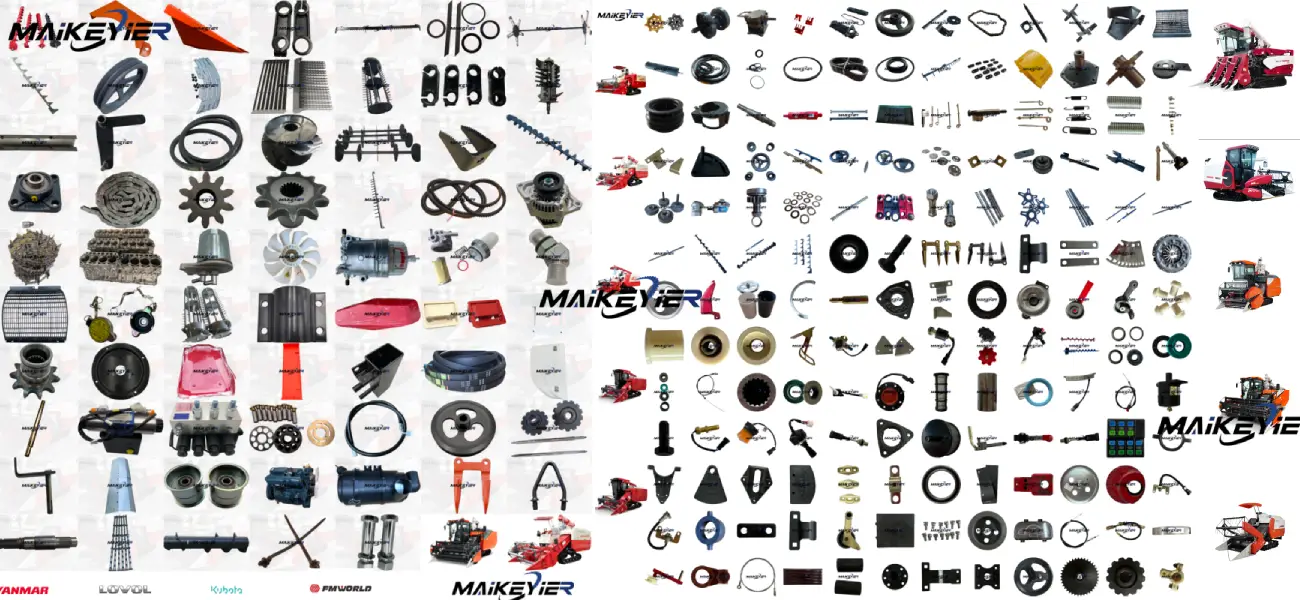
What to Ask During Procurement
If you have high requirements for part durability, you can ask the supplier for information such as the heat treatment process, hardness, whether carburizing or medium-frequency hardening is used, whether it is through hardening or tooth surface induction hardening, and hardened layer depth test data – to help you screen suppliers.
Maikeyier Solutions:
| Product Grade | Recommended Heat Treatment | Hardness Requirement | Case Depth |
| Ductile iron cast drive sprocket | Through hardening | HB 180-230 | Full cross-section |
| Forged steel 45#/40Cr drive sprocket | Tooth surface medium-frequency hardening | HRC 45-52 | 2.0-4.0mm |
| Alloy steel 42CrMo drive sprocket | Tooth surface medium-frequency hardening + overall quenching and tempering pre-treatment | HRC 50-56 | 3.0-5.0mm |
Frequently Asked Questions
If you have any further questions about heat treatment processes for drive sprockets, please feel free to ask.