
When we receive customer inquiries, we often see the terms “track guide” and “track chain” mentioned together – and sometimes even used interchangeably. This is because both the track guide and the track chain belong to the harvester’s undercarriage system and are located close to each other. Today, let’s take a closer look at these two products in terms of materials, applications, and more.
What Is a Combine Harvester Track Guide?
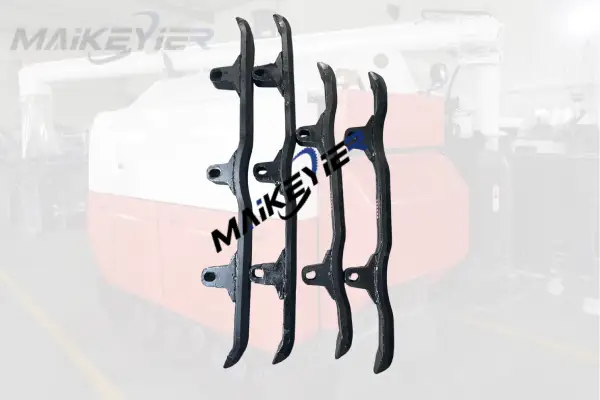
The Combine Harvester Track Guide (also called guide rail, track rail) is a fixed structural component installed inside the track frame. Its purpose is to keep the track running in a straight line and prevent derailment – especially during sharp turns, slope operations, and when the machine is subjected to lateral forces.
Track Guide Materials
- NM400 wear-resistant steel plate: High-end choice. Overall hardened to about 360–420 HBW; excellent wear resistance in muddy and sandy field conditions.
- 65Mn spring steel: Cost-effective standard option. After quenching and tempering, surface hardness reaches 45–55 HRC with good toughness.
- 40Cr alloy steel: Higher strength and hardenability than 65Mn. Surface induction hardening creates a wear-resistant shell with a tough core.
- QT600-3 ductile cast iron (casting): Used for thicker, more robust guide cross-sections. Good vibration damping and compressive strength, but impact toughness is lower than steel.
Track Guide Installation
- Position: Fixed along the inner side wall of the track frame, parallel to the track running direction.
- Mounting method: Secured to the frame brackets with high-strength bolts, or welded integrally during frame fabrication.
- Guidance direction: Depending on the track design, can be single-side guidance (inner only), double-side guidance (inner + outer), or center guidance.
- Clearance control: Precise clearance is maintained between the guide and the track chain/links – too tight creates friction and heat; too loose causes derailment.
- No moving parts: The guide itself does not rotate or bend. It is a static wear part and is replaced as a whole when worn to the limit.
Track Guide Functions
- Guiding the track: Keeps the rubber track or track chain running along the preset path on the track frame, preventing lateral deviation.
- Preventing derailment: During turns, slope operations, and obstacle crossing, the guide holds the track in place, resisting lateral forces that would otherwise cause derailment.
- Withstanding lateral loads: When the harvester turns or operates on uneven ground, the track pushes sideways against the guide. The guide must withstand this force without bending or breaking.
- Sacrificial wear: The guide is designed as a sacrificial wear part – it wears gradually and protects the more expensive track frame and track chain from premature damage.
What Is a Track Chain?
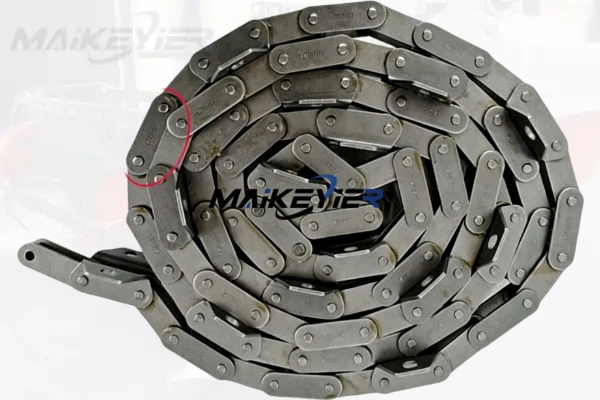
The Combine Harvester Track Chain (also called link assembly, track chain) is the moving component that connects individual links into a continuous loop. The track chain is embedded inside the rubber track and runs around the drive sprocket, idler wheels, track rollers, and track guides.
Track Chain Materials
- Forged 40Mn / 50Mn steel: Forged for high strength and impact resistance; surface hardened (induction or carburizing) to 50–58 HRC on contact surfaces.
- 40Cr / 42CrMo alloy steel: Higher tensile strength, better fatigue resistance, and improved hardenability – suitable for large-section links.
- Cast Mn13 (high-manganese steel / Hadfield steel): Austenitic work-hardening steel – extremely tough and impact-resistant; surface hardness increases with ground impact during use.
- Rubber-embedded (composite): Steel links provide structural strength; rubber provides traction, cushioning, and soil protection.
Track Chain Installation
- Routing: The chain loops around the drive sprocket (rear/front), the front idler, and lays along the bottom track rollers – forming a continuous loop.
- Tension adjustment: After installation, the track tension must be adjusted using a tensioning device (spring-type or hydraulic).
- Pin and bushing assembly: Each link is connected through a pin and bushing system. The pins engage with sprocket teeth to transmit drive power.
- Master pin: The track chain includes a removable master pin (or master link) that, when removed, allows the chain to be broken for installation or removal – all other pins are pressed in and cannot be removed without special tools.
- Rubber track integration: On rubber-track machines, the chain is embedded in the rubber track as a pre-inserted component and replaced as a complete unit.
Track Chain Functions
- Bearing machine weight: The chain (and links) bear the full weight of the harvester and distribute it across the ground contact area.
- Transmitting drive power: The drive sprocket engages the chain pins/bushings, converting engine power into forward/reverse motion.
- Providing traction: On rubber-track machines, the steel chain embedded in the rubber track provides structural support while the rubber provides traction. On steel-track machines, the steel link grousers bite directly into the ground.
- Articulated flexing: The chain flexes as it passes over sprockets and idlers, and extends along straight sections on the bottom – thousands of times per hour. Fatigue resistance is critical.
- Resisting ground abrasion: The bottom of the chain is constantly in contact with mud, sand, rice stubble, and gravel – requiring high wear resistance and corrosion resistance.
Why Do They Get Confused?
The track guide and track chain belong to the same chassis parts system, are located close to each other, and share overlapping failure modes and procurement scenarios – which are the main reasons customers mix them up.
They are located close together, both inside the track undercarriage
Both the track guide and the track chain are within the same track frame, both involve track movement, and both wear during field operation.
- Track chain: The metal link skeleton inside the track, looping around the drive sprocket and idler wheels.
- Track guide: Welded or bolted to the frame, pressing against the guide slot above the track chain – the two rub against each other during operation.
Confusing colloquial terminology
Both contain “rail” in common speech. Customers casually write “track rail” in emails, making it impossible to determine whether they need a static wear guide or a moving chain assembly.
- Track guide: Colloquially also called track guide bar, track rail.
- Track chain: Colloquially also called track link rail, crawler rail.
Overlapping failure symptoms
When either part is damaged, the symptoms look very similar: track misalignment, track derailment.
- Guide side wear → track misalignment, derailment.
- Chain elongation / link deformation → also track misalignment, derailment.
Both are long, steel-shaped components
- Track guide: Long, wear-resistant steel profile.
- Track chain: A complete long, closed-loop metal component.
How to Determine Which One You Need
Quick Identification Reference Table
| Question | If “Yes” → Track Guide | If “Yes” → Track Chain |
| Does this part move when the machine runs? | No – it is fixed to the frame | Yes – it rotates around the track frame |
| Is it a flat bar / guide profile? | Yes – usually flat steel or shaped bar | No – it is a chain with pins |
| Is it embedded inside the rubber track? | No | Yes (on rubber-track machines) |
| Does it engage with the drive sprocket? | No | Yes – the sprocket engages the chain pins |
| Does it bear the machine’s weight? | No – it only guides | Yes – it bears the full load |
| Does the part number contain “rail” or “chain”? | Contains rail / guide → track guide | Contains chain / link / assy → track chain |
Step-by-Step Identification
- Look at the symptoms: Track derailment, misalignment, uneven side wear? → Likely a guide issue. Loose track, sprocket tooth skipping, link breakage? → Likely a chain issue.
- Check the part number: Find the original part number from the machine’s parts manual or the old part. Guide numbers usually contain “rail,” “guide,” or “guide rail.” Chain numbers contain “chain,” “link,” “assembly,” or “track assy.”
- Take a photo: A clear photo of the worn/broken part is the fastest way for a supplier to identify the component. Send it along with the machine model and brand (e.g., Kubota DC70, Yanmar AG6, etc.).
- Confirm with your supplier: A professional supplier will verify the part before shipping. If the supplier can’t tell a guide from a chain – find another one.
Need the Right Track System Parts?
Maikeyier has been deeply involved in combine harvester track undercarriage parts – including track guides, track chains, track rollers, idler wheels, and drive sprockets – for over 20 years. We specialize in Japanese-brand harvesters (Kubota, Yanmar) and Chinese-brand harvesters (Lovol, World).



- 10,000+ SKUs in stock – covering the full track system
- Own forging plant – producing guides and links with sourcelevel quality control
- OEM parts and aftermarket parts – matching your budget and quality needs
- Serving 20+ countries – we understand the field conditions your machines work in
- Professional parts identification support – send us the part number or photo, and we’ll match it precisely
Contact Maikeyier – send us your harvester model, part number, or a photo of the worn part. We will help you confirm the exact component you need and ship it to your door on time.