
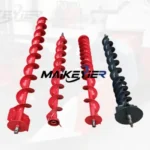
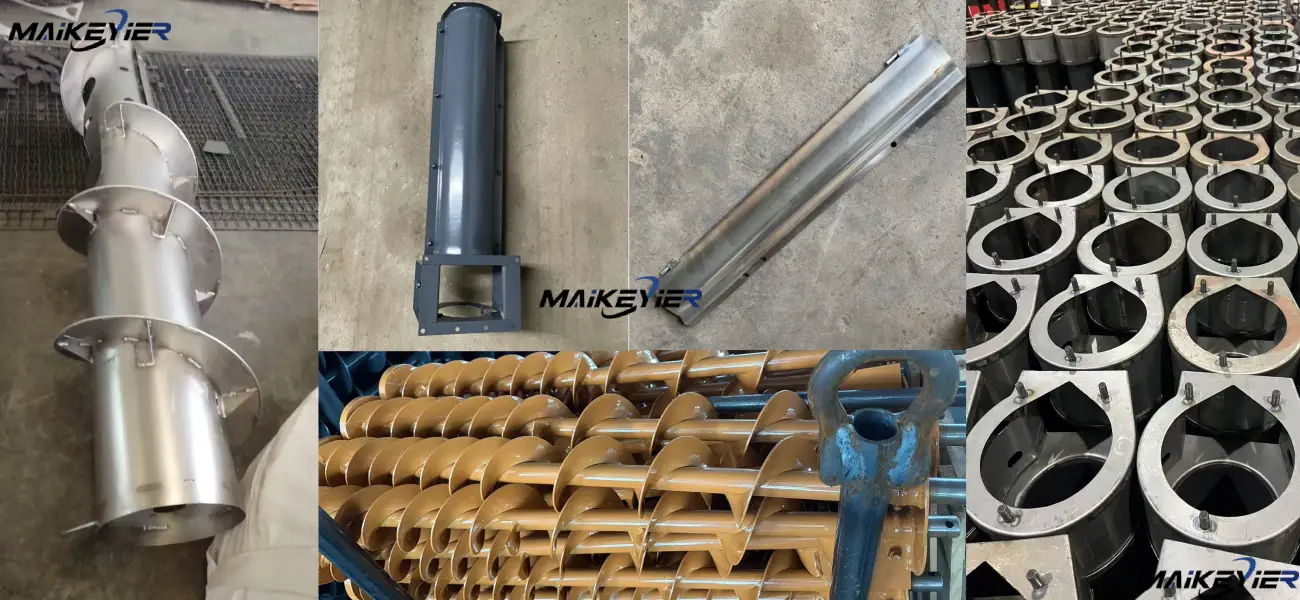
The Combine Harvester Auger is a core component of the combine harvester’s conveying system, responsible for the conveying, lifting, and transfer of grain, straw, and other materials. Maikeyier provides overseas agricultural parts dealers, wholesalers, repair shops, and importers with combine harvester vertical grain augers, horizontal grain augers, vertical tailings augers, horizontal tailings augers, and related harvester parts. We support OEM/aftermarket supply, bulk procurement, and mixed-lot orders for multiple models.
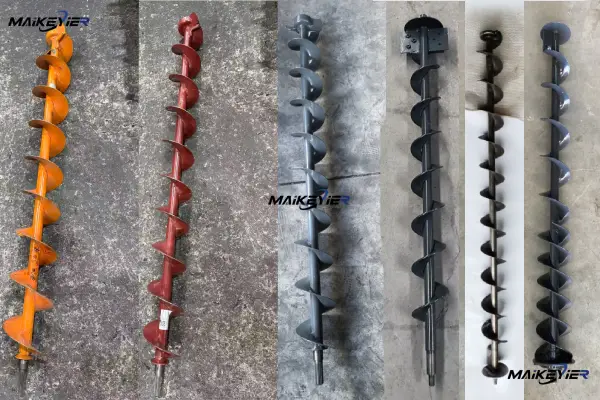
Main Components of the Combine Harvester Auger
Harvester augers are primarily used for conveying, lifting, and transferring grain, straw, and other materials. Different brands and models vary significantly in structure. Two augers with the same name may have completely different lengths, shaft end configurations, flight pitches, and rotation directions. When procuring augers, be sure to match them using the machine model, OEM number, dimensions, and photos.
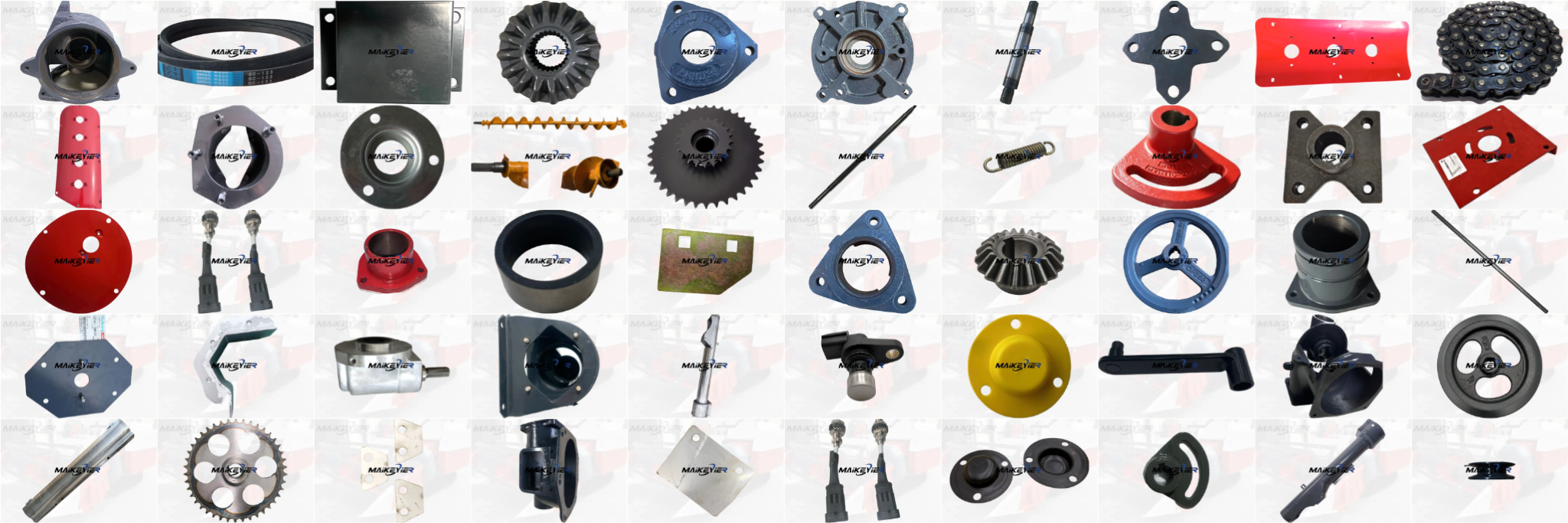
- Auger Shaft: The central rotating shaft that transmits torque.
- Flighting / Auger Flight: The spiral conveying flight.
- Spiral Blade Segments: Individual flight sections welded onto the shaft.
- Bearing: Supports the rotating assembly.
- Bearing Housing: Mounts the bearing to the frame.
- Gear / Sprocket: Transmits power to the auger.
- Coupling / Universal Joint: Connects driven sections, especially on folding unloading augers.
- End Cover / Tube: Enclosed housing in some designs.
- Support Components: Intermediate bearings, hangers, brackets.
- Fasteners: Bolts, nuts, keys, retaining components.
Combine Harvester Auger Materials
Augers are in continuous contact with grain, stalks, and soil contaminants, operating under constant rotation and friction. Material selection directly determines service life. Under normal conditions, 45# steel is recommended for the main shaft and Q235 for flights. For high-load or humid environments, 40CrMo or 20CrMo can be used for the shaft, and stainless steel for flights. Maikeyier can provide customized material solutions based on the customer’s operating environment, crop type, and workload.
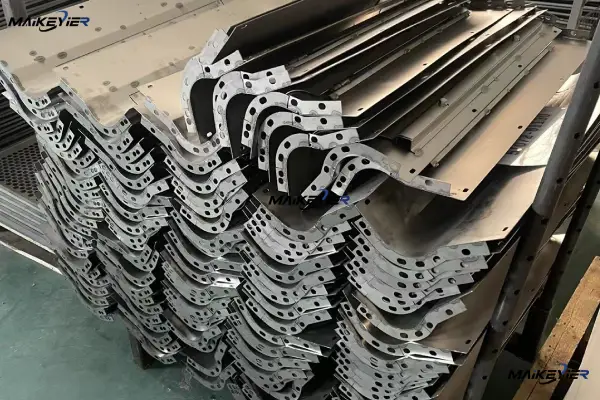
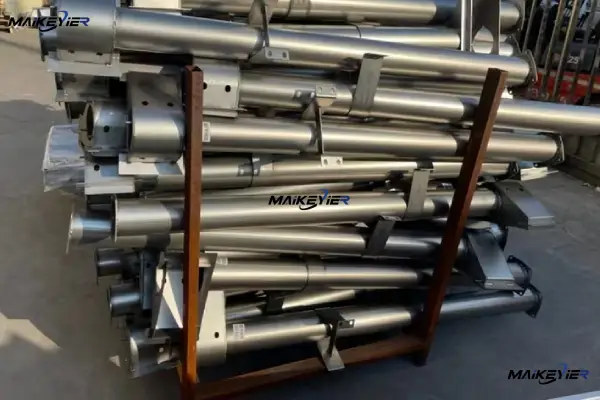
Common Materials Used by Maikeyier for Augers
| Material | Properties | Applicable Parts | Applicable Scenarios |
| 45# Steel | Medium carbon steel; high strength and good wear resistance after quenching and tempering | Auger main shaft, splined shaft ends | Conventional harvesting; applications with high strength requirements |
| Q235 | Low carbon steel; good plasticity, excellent weldability, low cost | Spiral flights, non-load-bearing parts | Conveying applications with low strength requirements |
| 40CrMo | Alloy steel; high hardenability, excellent fatigue resistance | Heavy-duty auger shafts, high-strength splined shafts | Large harvesters, high-load continuous operations |
| 20CrMo | Carburizing steel; hard surface, tough core | Splined shaft ends, gear drive areas | Applications requiring surface wear resistance + core toughness |
Flight Materials
| Material | Properties | Applicable Scenarios |
| Q235 Flights | Low cost, good workability | Conventional harvesting, mild wear conditions |
| Stainless Steel Flights | Corrosion-resistant, rust-proof | Humid environments, high-moisture crops, export markets |
Manufacturing Process of Combine Harvester Auger
Maikeyier has complete auger manufacturing capabilities, with full process control from raw materials to harvester parts.
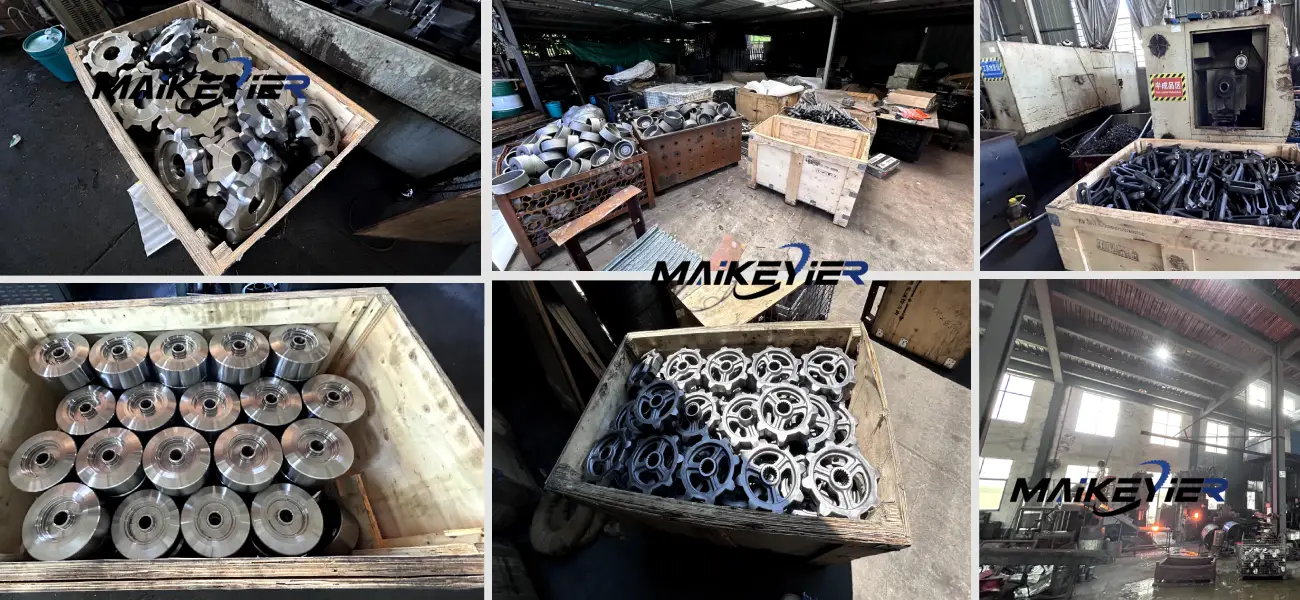
Process
| Process Step | Processing Content and Requirements | Key Quality Control Points (CTQ) |
| Raw material selection | 45#, Q235, 40CrMo, 20CrMo steel and stainless steel plates selected based on working conditions; 100% spectroscopic inspection upon incoming | Chemical composition meets standards; no surface cracks or inclusions |
| Shaft machining | Cutting → rough turning → finish turning of auger shaft, machining shaft body, splines, steps, and other key features | Journal dimensional accuracy; spline parameter correctness; step positioning dimensions |
| Spiral flight manufacturing | Cold-rolled or hot-wound forming per drawings; precise control of helix angle, OD, ID, and pitch | Pitch uniformity (uneven pitch causes material pulsation and machine vibration); flight thickness consistency |
| Welding | Reliable welding of flights to shaft; uniform welds, no cold lap, no undercut | Weld penetration and integrity (field failures often crack here) |
| Precision machining | Finish machining of splined shaft ends, splined sleeves, mounting positions, etc., to ensure assembly accuracy | Splined shaft end concentricity; mounting position dimensional tolerances |
| Heat treatment | 45# shaft quenched and tempered (hardened + high-temperature tempered) to HB 220-280; splined shaft ends may be carburized to specified case depth | Surface hardness (HRC/HB); core toughness; case depth |
| Surface treatment | Selected based on customer requirements and storage/transport conditions – oiling, powder coating, induction hardening, or carburizing (see detailed table below) | Coating thickness/adhesion; rust prevention period compliance |
| Assembly | Assembly of bearings, gears, sprockets, couplings, and other components | Bearing clearance; gear/sprocket mesh clearance; fastener locking torque |
| Final inspection | Comprehensive inspection: appearance, critical dimensions, straightness, weld quality, rotational balance, surface treatment quality | Shaft straightness (runout); dynamic balance precision; installation dimensions verified against drawings/OEM parts |
Surface Treatment Options
| Surface Treatment | Core Function | Hardness/Performance | Recommended Scenarios |
| Oiling (anti-rust oil) | Basic rust protection | Rust protection period approx. 3-6 months | Inland dry areas, short-term use, economy orders |
| Powder coating | Thick coating, corrosion-resistant, good appearance | Coating thickness ≥ 60μm, strong adhesion | Export sea freight, humid/rainy markets, customers with high appearance requirements |
| Induction hardening | Surface hardness increase, excellent wear resistance | Hardness up to HRC 50-55 | High-wear applications, heavy-duty augers, abrasive material conveying |
| Carburizing | Very high surface hardness with tough core | Case depth 0.8-1.2mm, surface hardness HRC 58-62 | Splined shaft ends and other critical parts subject to impact and wear |
Why Choose Maikeyier for Combine Harvester Augers?
At Maikeyier, customers can consolidate augers with other harvester parts in a single order. For example: Auger + Cutter Parts + Wear Parts + Belts + Bearings + Sheet Metal Parts. Mixed-lot orders lower procurement thresholds and inventory pressure, enabling more flexible inventory management.
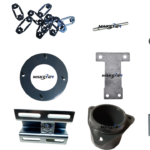
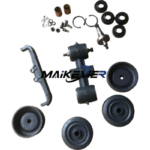
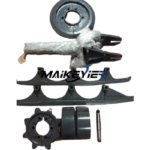

Maikeyier Services
Professional Agricultural Machinery Parts Supplier
- Long-term focus on the R&D and supply of harvester, tractor, and other agricultural machinery parts, with deep understanding of the demanding field conditions in which these parts operate.
Manufacturing + Supply Chain Integration
- In addition to in-house manufacturing capabilities (forging, sheet metal, machining, heat treatment), we also have a mature agricultural parts supply chain network. We combine Self-Manufacturing + Partner Factories + Quality Control + Export Service to provide customers with more complete product solutions.
One-Stop Combine Harvester Parts Supply
- In addition to augers, Maikeyier also supplies: Cutting System (Cutter Bar, Cutter Knife); Threshing System (Concave, Threshing Parts); Chassis & Undercarriage (Track Roller, Drive Sprocket, Idler); Drive System (Pulley, Belt, Bearing, Gear, Chain); Sheet Metal Parts; Rubber Parts, etc. This helps customers reduce communication, logistics, and inventory pressure from multiple suppliers – one supplier, one order, one delivery.
Quality Control
- From raw material incoming to finished product dispatch, every batch undergoes chemical composition inspection, visual inspection, critical dimension inspection, and surface treatment inspection to ensure consistent quality.
Combine Harvester Auger Structural Design
Maikeyier auger products offer multiple structural design options to meet different operating conditions and cost requirements.
Shaft Structure
| Structure Type | Features | Applicable Scenarios |
| Solid shaft | High strength, good rigidity, strong bending resistance | Heavy-duty augers, long-span conveying |
| Hollow shaft | Lightweight, lower cost | Standard conveying, light-load applications |
Shaft End Types
| Type | Features | Applicable Scenarios |
| Splined shaft end | High torque transmission, reliable connection | Unloading augers, power input ends |
| Splined sleeve | Used with splined shafts for easy assembly/disassembly | Augers requiring quick replacement |
Flight Thickness
| Thickness | Applicable Scenarios |
| 2mm | Light conveying, fine particles |
| 3mm | Conventional harvesting; most widely used on the market |
| 4mm | Heavy-duty conveying, coarse-stalk crops, high-wear conditions |
Surface Treatment
| Treatment | Rust/Wear Protection | Applicable Scenarios |
| Oiling | Basic rust protection | Inland dry areas, short-term use |
| Powder coating | Thick coating, corrosion-resistant | Export sea freight, humid markets |
| Induction hardening | Surface hardness increase | High-wear conditions |
| Carburizing | Very high surface hardness + tough core | Critical parts such as splined shaft ends |
Material Combination Recommendations
| Combination | Shaft | Flights | Applicable Scenarios |
| Standard | 45# | Q235 (3mm) | Conventional harvesting, standard conditions |
| Reinforced | 45# | Q235 (4mm) | High-yield crops, coarse-stalk conditions |
| Heavy-duty | 40CrMo | Q235 (4mm) / Stainless steel | Large harvesters, continuous high-load operations |
| Corrosion-resistant | 45# | Stainless steel (3mm) | Humid environments, paddy field operations |
Combine Harvester Parts Wholesale
For overseas agricultural parts wholesalers and dealers, Maikeyier supports:
- Bulk Orders
- Mixed Orders
- Multiple Models
- Aftermarket Parts
- OEM Replacement Parts
- Export Packaging
- Container Loading
- One-Stop Procurement
Combine Harvester Brands We Supply
Maikeyier supplies augers and parts for the following mainstream harvester brands:
| Brand | Main Models |
| Kubota | DC70, DC105, PRO series, AR series, R series |
| Yanmar | AW70V, AW82V, AG series, C series, Y series |
| Lovol | RG series |
| FM World | 4LZ series |
Combine Harvester Auger for Different Crops
For different crops, Maikeyier can provide targeted matching in terms of flight structure, material selection, wear resistance, and conveying efficiency.
| Crop | Auger Requirements |
| Rice | Grain is fragile – requires gentle conveying; humid conditions require rust protection |
| Wheat | Long stalks – requires higher conveying capacity |
| Corn | Large, heavy kernels – requires high flight wear resistance |
| Soybeans | Easily damaged – requires controlled conveying speed |
| Barley | Similar to wheat – conveying capacity required |
| Other grains | Matched according to crop characteristics |