
Every combine harvester contains two vertical conveying lines that almost no one notices until they clog: one is the grain elevator that lifts clean grain into the grain tank, and the other is the tailings elevator that returns unthreshed heads back to the threshing unit for a second pass. Dealers and repair shops often confuse these two assemblies, and confusion costs money. In the parts catalog they look very similar – both are vertical auger conveying mechanisms with top discharge and bottom drive – but they convey different materials, have different wear causes, and share very few common parts. Today, let’s take a fresh look at these two critical areas with Maikeyier!
Position of the Two Elevators in the Material Flow
First, let’s follow the grain through the combine harvester to understand why a harvester needs two independent vertical conveying mechanisms!
Operation
- After the harvester header completes cutting and gathering, it feeds the crop into the threshing unit.
- The threshing unit separates grain from straw. Clean grain falls through the concave, straw is discharged from the rear of the machine, and a portion of unthreshed heads, short straw, and grain mixture exits from the sieve surface as tailings.
- Clean grain falls to the bottom of the grain pan, is collected by the horizontal auger and pushed to the inlet of the vertical elevator. The grain elevator lifts it vertically, then throws it into the grain tank through rotating discharge paddles at the top.
- Meanwhile, the tailings line lifts the unthreshed heads and straw-grain mixture back to the threshing unit for a second pass, rather than discharging it directly from the rear.
Comparison
These two assemblies are mounted side by side on the same machine, performing the same physical task – using a vertical auger to move material upward – but they belong to two different circuits with completely different wear characteristics.
| Comparison Item | Grain Elevator Assembly (Clean Grain) | Tailings Elevator Assembly (Tailings / Returns) |
| Conveyed material | Clean grain – rice, wheat | Tailings – unthreshed heads, short straw, grain mixture |
| Flow direction | Grain pan → Grain tank | Sieve surface tailings → Return to threshing unit |
| Additional function | None – pure conveying | Re-threshing while conveying (re-threshing teeth + re-threshing housing) |
| Drive method | Bevel gearbox + drive pulley | Bevel gearbox + chain case assembly (13-tooth sprocket) |
Grain Elevator Assembly: Structure and Working Principle
The grain elevator is the simpler of the two. Its task is to move clean grain upward as gently as possible.
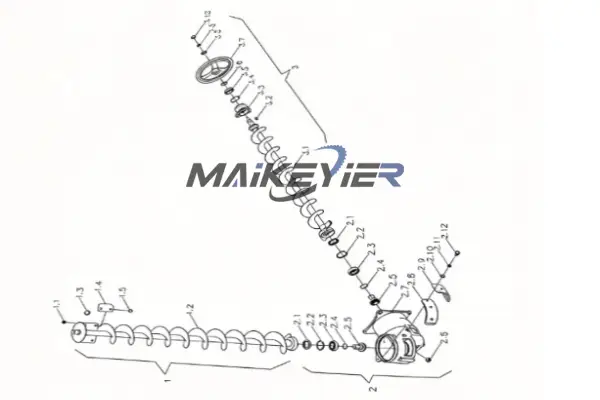
Five Major Sub-Assemblies
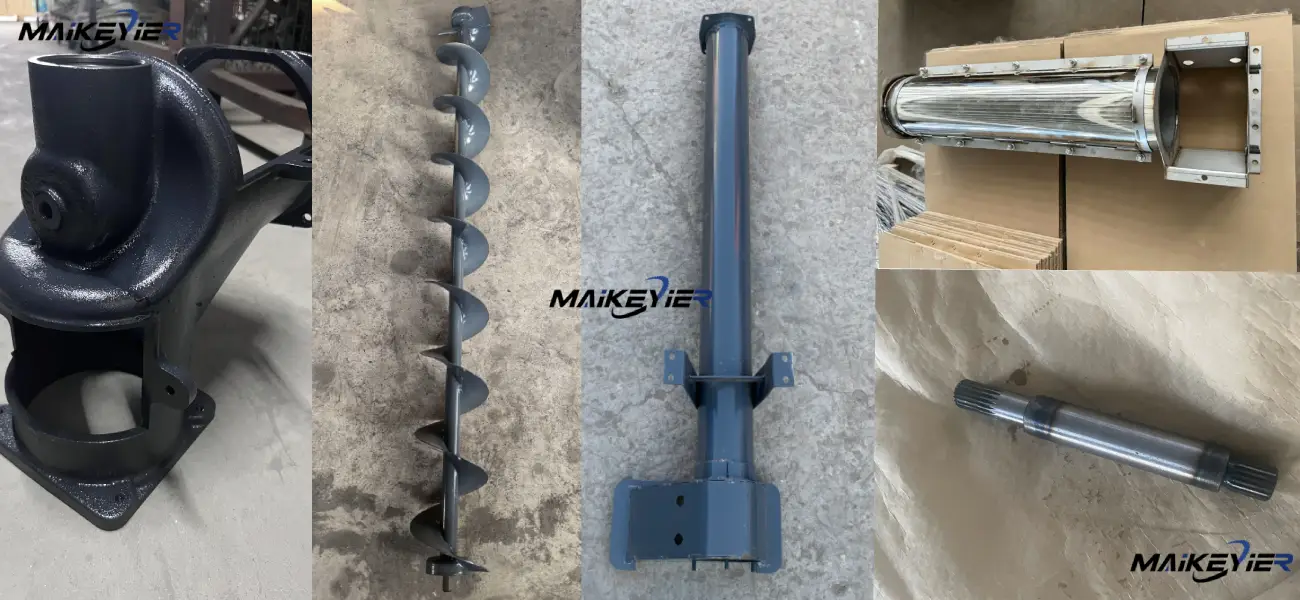
- Grain Horizontal Auger Assembly: A horizontal screw conveying mechanism that collects grain from the bottom of the grain pan and pushes it to the vertical section inlet. It is supported in a bearing housing, uses bearing 6205, and is driven by a drive pulley.
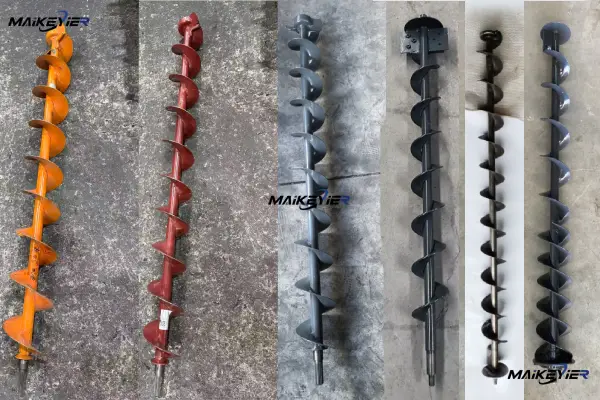
- Grain Vertical Auger Assembly: The tall vertical screw responsible for lifting. Key details: welded flights (vertical auger weldment), balance weights welded to the shaft (to counteract vibration), and discharge paddles at the top that throw grain into the grain tank.
- Vertical Housing Weldment and Grain Tank Body Combination: The outer tube and lower chamber connecting the horizontal/vertical sections, with inspection windows for the operator to observe grain flow.
- Grain Drive Gearbox: A bevel gearbox that turns machine power through 90° to input into the vertical auger. It contains a pair of 15-tooth bevel gears, bearing 6205, adjusting shims, and oil filler plug.
- Inspection Window Assembly: Two windows on the housing: the operator uses these to judge grain flow and detect blockages before they become failures.
Seals
The elevator operates surrounded by dust, moisture, and fine chaff. Every rotating fit on the assembly is protected by an inner skeleton rotary shaft lip seal, with hole-type circlips and shaft-type circlips positioning the bearings. Seals are cheap; the bearings and shafts they protect are expensive – a leaking seal is always the first warning that a bearing is about to fail.
Key Components Summary
| Name | Function |
| Grain Elevator Assembly (complete) | Clean grain lifting |
| Grain Horizontal Auger Assembly | Collects grain from grain pan |
| Grain Vertical Auger Assembly | Vertically lifts grain |
| Vertical Auger Weldment | Auger flights and shaft core |
| Discharge Paddles | Throws grain into grain tank |
| Balance Weight | Balances auger, reduces vibration |
| Grain Drive Gearbox | Bevel gearbox, 90° direction change |
| 15-Tooth Bevel Gears (2 pcs) | Direction change transmission in gearbox |
| Bearing 6205 | Auger and drive support |
| Bearing 6005 | Top support bearing |
| Inspection Window Assembly | Flow observation |
| Inner Skeleton Rotary Shaft Lip Seal | Rotating point sealing |
Tailings Elevator Assembly: Secondary Elevator
The tailings elevator conveys a wet, sticky, irregularly shaped mixture of unthreshed heads and short straw – the most difficult material to convey on the entire machine. At the same time, it must complete re-threshing while lifting, so its structure is fundamentally heavier and stronger than the grain elevator.
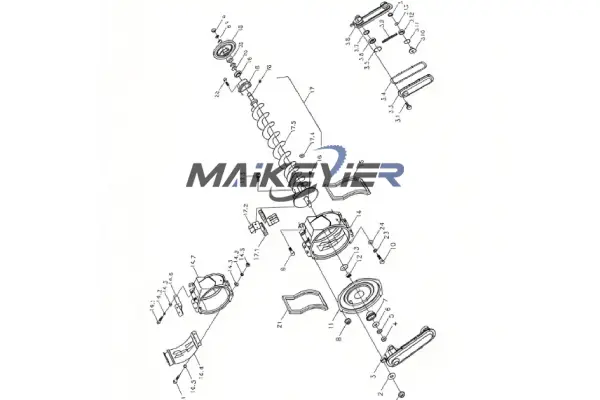
Re-Threshing Section
- Re-threshing Housing Assembly / Re-threshing Housing Weldment: Heavy-duty welded chamber at the lower part of the elevator
- Re-threshing Teeth Weldment 1 / Re-threshing Teeth Weldment 2: Tooth plates mounted on the horizontal auger with hex socket combination bolts, striking unthreshed heads inside the housing to release grain
- Tooth Plate Weldment: The counter-rotating surface inside the housing that works with the re-threshing teeth
- Horizontal Auger Assembly and Tailings Horizontal Auger Weldment: Collects tailings from the sieve surface and feeds them into the vertical section
Drive Section
The grain elevator uses a pulley and gearbox, while this model’s tailings elevator is driven through a chain case assembly:
- Chain Case with Chain Assembly and Two Sprockets – 13-tooth and 15-tooth – with shaft-type circlips for positioning
- Bevel Gearbox containing a pair of 15-tooth bevel gears, with deep groove ball bearings 6304-2RS and 6002-2RS, intermediate shaft, adjusting shims, and small cover assembly
- Full-process sealing: Lip seals, plus sealing rubber, dust covers, and drive-end sealing rubber sleeves
- Compared with belts, chain drive better withstands the heavy, wet loads of tailings, but it brings its own wear patterns.
Vertical Auger and Top Discharge
- Vertical Auger Assembly and Tailings Vertical Auger Weldment
- Top Balance Weight and Discharge Paddles – throw tailings back to the threshing unit
- Tailings Housing Assembly and Tailings Housing Weldment, with internal liners and cover assembly – the liner inside the housing is a replaceable wear part
- Top Cover Assembly and Shaft End Guard, protecting the top bearing
Key Components Summary
| Name | Function |
| Tailings Elevator Assembly (complete) | Tailings / returns lifting |
| Re-threshing Teeth Weldment 1/2 | Strikes unthreshed heads to release grain |
| Tooth Plate Weldment | Counter-rotating surface working with re-threshing teeth |
| Horizontal Auger Assembly | Collects tailings from sieve surface |
| Vertical Auger Assembly | Vertically lifts tailings |
| Discharge Paddles | Throws back to threshing unit |
| Balance Weight | Balances auger, reduces vibration |
| Chain Case / Chain Assembly | Chain drive |
| 13-Tooth / 15-Tooth Sprockets | Chain drive |
| Bevel Gearbox | 90° direction change |
| Bearings 6304-2RS / 6002-2RS | Gearbox support |
| Lip Seals / Sealing Rubber Sleeves | Rotating point sealing |
| Liner | Replaceable wear part inside housing |
Common Faults: Symptoms, Causes and Solutions
| Symptom | Most Likely Cause | Solution |
| Broken grain in grain tank | Discharge paddles worn or deformed; auger speed too high; bent flights | Replace discharge paddles; verify drive speed; straighten or replace auger |
| Top of elevator clogged | Discharge paddles worn, causing grain backflow; wet grain; excessive feed | Replace paddles; reduce feed; check grain tank inlet for obstruction |
| Sudden increase in returns / grain discharged from machine | Re-threshing teeth and tooth plate worn round | Replace re-threshing teeth and tooth plate as a set |
| Rhythmic knocking from lower part | Chain elongation or sprocket teeth blunt (tailings elevator) | Replace chain assembly and both sprockets as a set |
| Gearbox abnormal noise or humming | Bevel gear tooth surface wear or lack of oil; bearings 6304/6002 failed | Check oil level and plug; replace gear pair and bearings |
| Oil/grease leakage at drive end | Lip seal or sealing rubber sleeve worn | Replace seals before bearing failure occurs |
| Excessive vibration of vertical auger | Balance weight detached or weld cracked; shaft bent | Replace auger weldment or rebalance |
| Elevator not turning / seized | Bearing seized after seal failure; foreign object jammed at top | Disassemble and inspect; replace bearings and seals; remove foreign object |
| Tailings elevator overloading machine | Re-threshing teeth worn; concave clearance too large; excessive return material | Replace re-threshing teeth; readjust concave clearance; review fan and sieve settings |
Maintenance: What to Check and When
| Interval | Grain Elevator | Tailings Elevator |
| Daily / pre-operation | Check grain flow through inspection windows; listen for abnormal noise | Listen for abnormal noise from chain case; check for material buildup around re-threshing housing |
| Every 50 hours | Check gearbox oil level; check for leakage at upper and lower bearings | Check chain tension and lubrication; check re-threshing teeth height |
| Every 100-200 hours | Check auger flights for deformation; check balance weight welds; lubricate bearings | Check tooth plate and housing liner; check bevel gearbox oil level and gear mesh |
| Every season | Replace lip seals if leakage found; replace bearings with play; replace discharge paddles if worn | Replace re-threshing teeth and tooth plate; replace chain and sprockets as a set; measure liner thickness; replace discharge paddles if worn |
| End of season | Clean housing interior; apply anti-rust oil to bare metal; store indoors | Empty and flush gearbox area, remove moisture residue; protect seals from drying and cracking |
Frequently Asked Questions (FAQ)/h2>
Q1: What is the difference between the grain elevator and the tailings elevator?
A: The grain elevator lifts clean grain from the grain pan to the grain tank; the tailings elevator (also called secondary elevator or returns elevator, listed as tailings elevator assembly in the parts catalog) returns unthreshed heads and short straw from the sieve surface back to the threshing unit and re-threshes them along the way. They are independent assemblies with independent part numbers.
Q2: The sieves are adjusted correctly, so why is grain still leaking from the rear?
A: First check the re-threshing teeth and tooth plate. Once they are worn round, unthreshed heads carry grain back in the return flow, the return volume increases, and material is discharged from the machine without being threshed. Replacing the re-threshing teeth and tooth plate as a set is far cheaper than repeatedly adjusting the sieves.
Q3: Grain in the grain tank is broken. Where should I check?
A: Usually the discharge paddles at the top of the vertical auger are worn or deformed – they no longer throw grain cleanly and cause backflow. Also check the straightness of the auger flights and the drive speed; excessive speed damages grain more than any other factor.
Q4: Can I replace only the chain without replacing the sprockets?
A: They must be replaced as a set. A new chain paired with hooked or worn 13-tooth/15-tooth sprockets will elongate and skip teeth again within days. The cost of two sprockets is far less than the cost of a mid-season breakdown.
Q5: How do I know when the lip seal needs replacement?
A: Visible oil or grease traces at rotating fits, or material sticking to the housing around the bearing, indicates the seal is leaking. Replace immediately – its price is only a fraction of the bearing and shaft it protects.
Q6: Do you supply complete assemblies or only parts?
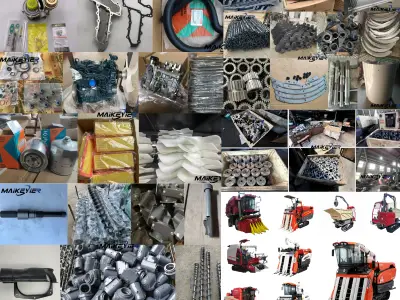
A: Both. Maikeyier can supply individual wear parts (re-threshing teeth, discharge paddles, seals, bearings, sprockets), sub-assemblies (horizontal/vertical augers, chain case, gearbox), and complete assemblies, matched by model and OEM part number.
The grain elevator and tailings elevator are the two quietest systems on a rice harvester. Knowing which parts actually wear and ordering by assembly number rather than part name is the shortest path to reducing rework and keeping customers satisfied.

If you are stocking conveying parts for Lovol RG series, Kubota DC series, Yanmar AW series, or World rice harvesters, send your model and part numbers to Maikeyier. We will confirm the corresponding assembly, quote individual or complete assembly prices, and ship in the same container with your other parts.